Thalidomide, a representative chiral drug, was marketed as an analgesic and sedative, but was withdrawn after severe teratogenic side effects were reported in pregnant women. In recent years, however, thalidomide has regained attention as its therapeutic efficacy against several intractable diseases — including Hansen's disease and multiple myeloma — has been reported, leading to renewed market approval.
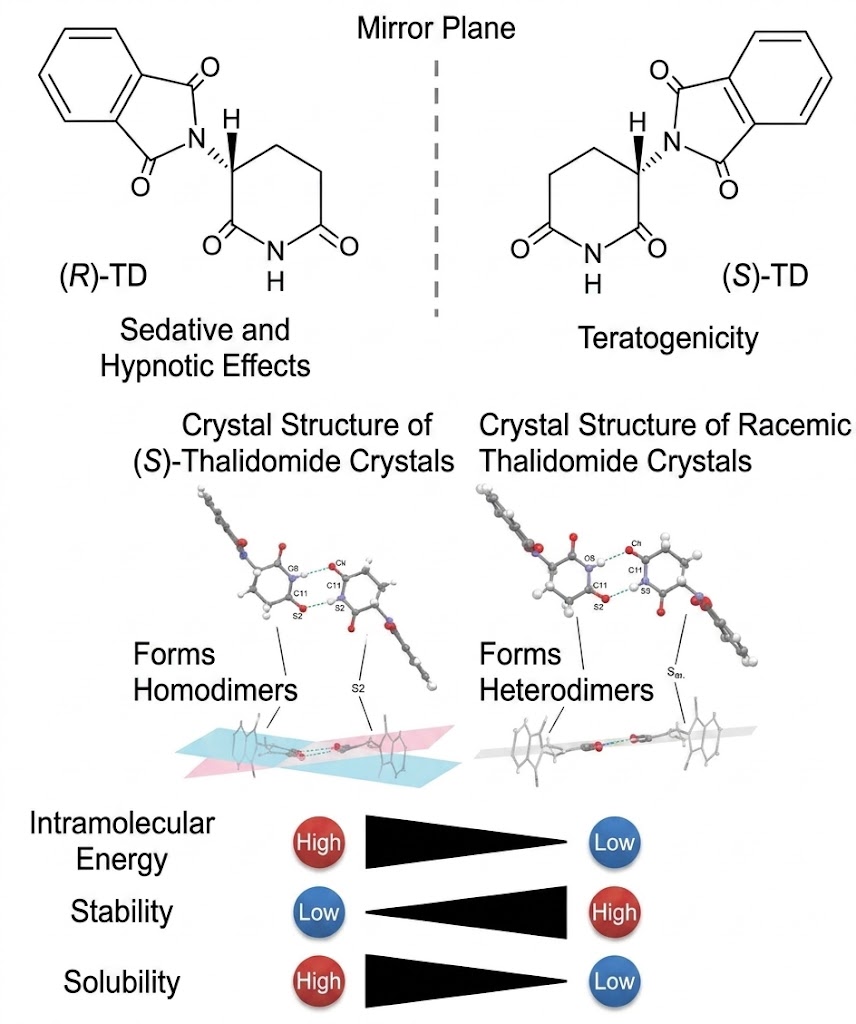
The pharmacological effects of thalidomide differ markedly depending on its chirality. Furthermore, since the chirality of thalidomide can invert under certain conditions, it is essential from a safety standpoint to evaluate under what conditions chiral inversion occurs. Despite the fact that thalidomide is sold and consumed in the solid state, almost all research on its chirality has been conducted in solution; solid-state studies are extremely rare.
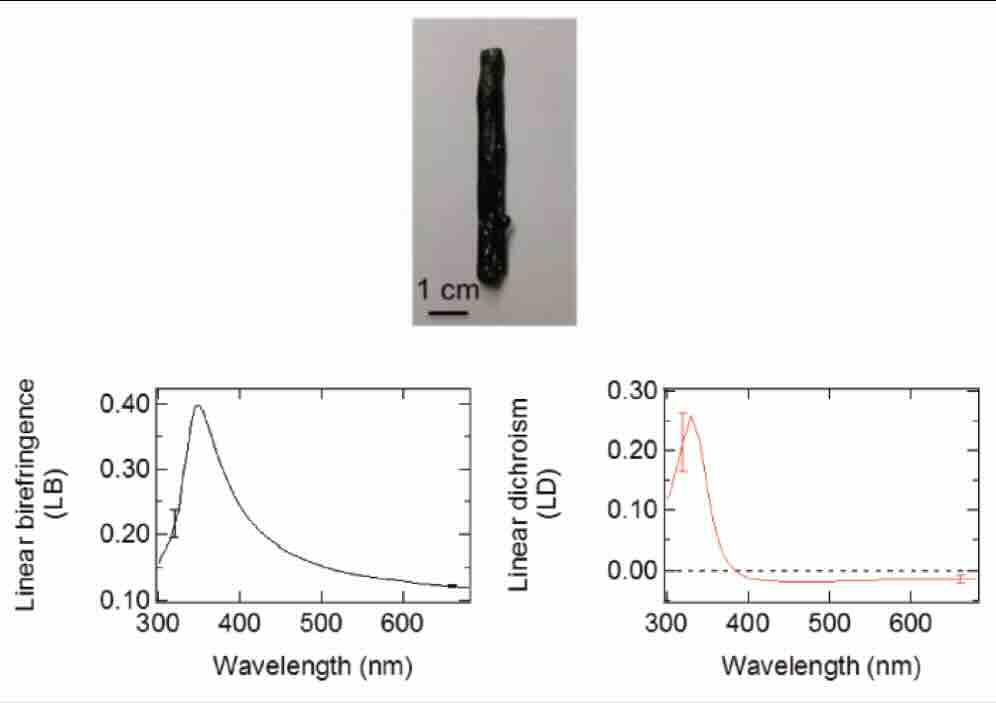
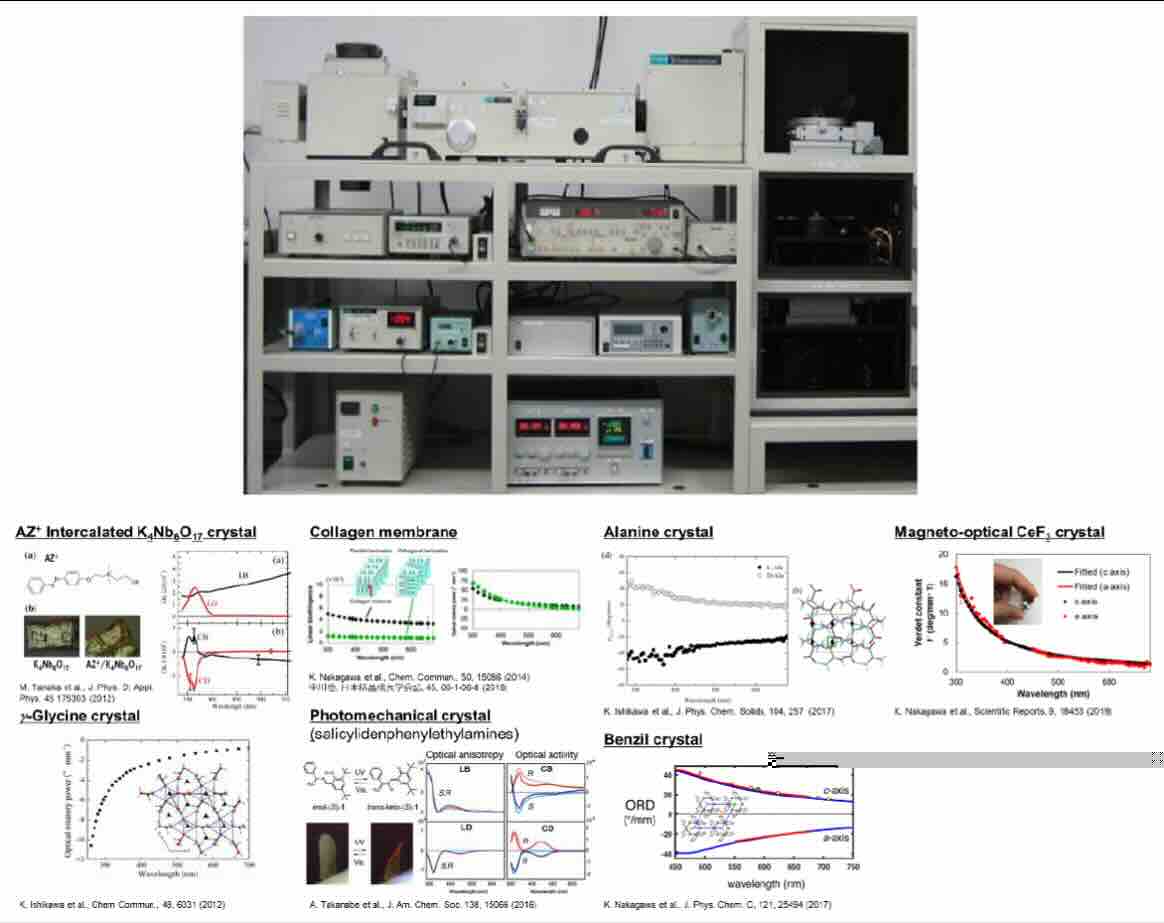
In this research, we use the G-HAUP — an optical measurement instrument developed uniquely by our group — to evaluate the chirality of solid-state thalidomide "in situ," thereby striving to more accurately elucidate the physicochemical properties of solid-state thalidomide, including its stability and reactivity (chiral inversion and hydrolysis).
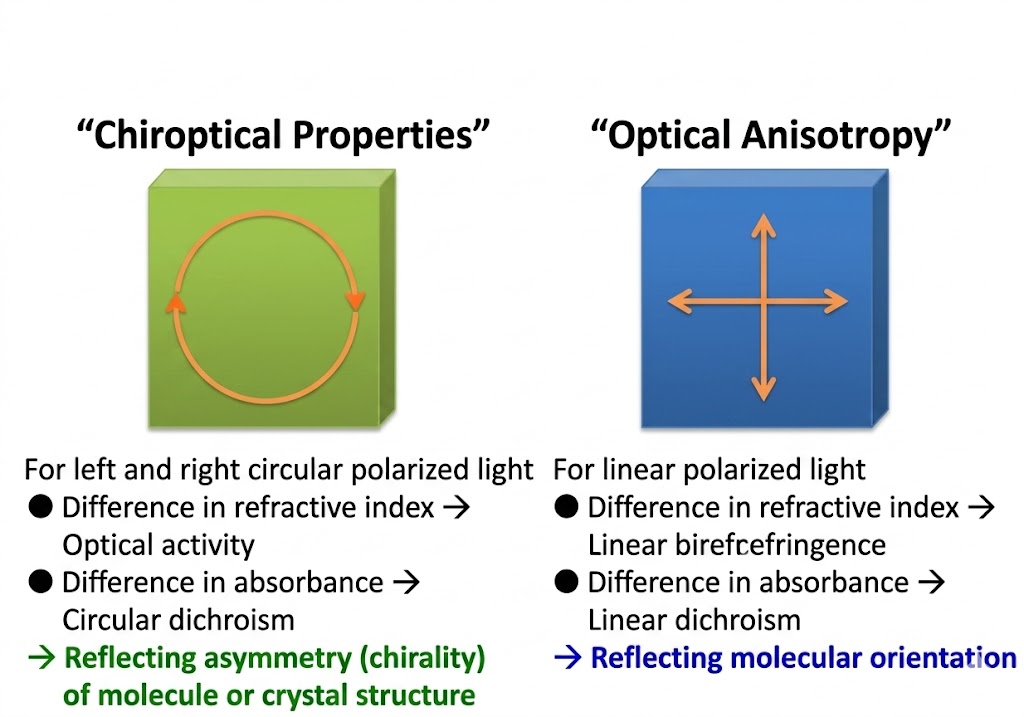
We grew thalidomide crystals by solvent evaporation, and through single-crystal X-ray structure analysis and quantum chemical calculations, we were the first in the world to demonstrate that differences in physicochemical properties such as melting point and solubility originate from differences in crystal structure [1]. We also determined the absolute structure of the thalidomide metabolite CBG, which had not previously been established [2], and elucidated the hydrolysis and dehydration reaction mechanisms among metabolites including thalidomide and CBG [3–5]. Furthermore, we developed a crystal growth method by sublimation and experimentally demonstrated the possibility of chiral inversion of thalidomide in the gas phase [6, 7]. We were the first in the world to measure the temperature dependence of enantiomeric and racemic crystals, revealing that a distinct difference in thermal expansion behavior arises due to a subtle symmetry difference in the dimers [8]. We also systematically investigated the chiroptical properties of thalidomide (TD) through circular dichroism and optical rotation measurements in several solvents, including the polar aprotic solvent acetonitrile [9].
Related Publications
- [1] T. Suzuki, T. Asahi et al., Phase Transitions, 83, 223–234 (2010).
- [2] K. Otogawa, T. Asahi et al., Acta Cryst. E, 71, 107–109 (2015).
- [3] Y. Ogino, T. Asahi et al., J. Theor. Biol., 373, 117–131 (2015).
- [4] Y. Ogino, T. Asahi et al., Chirality, 29, 282–293 (2017).
- [5] T. Taniguchi, T. Asahi et al., Chem. Lett., 50, 1388–1391 (2021).
- [6] M. Kira, Y. Shiga, K. Nakagawa, T. Asahi et al., Cryst. Growth Des., 24, 3133–3139 (2024).
- [7] K. Nakagawa, M. Kira, T. Asahi, Monthly Saibo (in Japanese), 56, 1009–1013 (2024).
- [8] A. Matsumoto, K. Nakagawa, T. Nakanishi, M. Kira, T. Asahi, J. Am. Chem. Soc., 147, 11988–11997 (2025).
- [9] K. Okano, M. Iwata, M. Kira, A. Matsumoto, T. Nakanishi, N. Shibata, T. Asahi, K. Nakagawa, Chem. Lett., 55, upag158 (2026).
Press release
Structural changes of thalidomide crystals with temperature revealed (Waseda University)Press coverage
- [1] Kagaku Shimbun “Structural change of thalidomide crystal due to temperature elucidated” May 16, 2025 (Printed on page 4)
- [2] Nikkei (electronic edition) “Waseda, Tokyo Tech, Nagoya Tech, UTokyo elucidate temperature-dependent structural changes in thalidomide crystals” April 10, 2025